
We use necessary cookies that allow our site to work. We also set optional cookies that help us improve our website. For more information about the types of cookies we use, visit our Cookies policy.

Cookie settings
shout-phone-user

In this report, Dr Emilia Piwek from our Data Insights team explores insights from user feedback submitted to Shout.

This report explores insights from user feedback submitted to Shout – our volunteer-led mental health support service – and how we use them to improve service quality.

Most texters who chose to leave feedback (84%) found their conversation helpful, often highlighting volunteer empathy, space to share their feelings, prompt replies, and useful advice. Those who were dissatisfied commonly cited abrupt endings and conversations feeling robotic.

These findings have since informed updated volunteer guidance and monitoring systems to better support service quality.

“My volunteer was very kind, useful and helpful. I'm really grateful for her helping me”

Shout Texter

Background

Shout is a free, volunteer-led text service providing 24/7 anonymous crisis support across the UK. Since our launch in 2018, we have carried out more than 3 million conversations with people in need, 1.2 million of which were taken in the last two years alone. With such high levels of demand, we are committed to providing and maintaining the highest level of service quality.

To understand what Shout texters appreciate about the service and identify any areas for improvement, we listen to their experience in a number of ways. This includes consulting with the Shout service User Voice Group and partnering with academic institutions to analyse the thoughts of particular demographic groups. In these ways, we can explore individual user experiences and needs in great detail; however, the greater the depth, the smaller the number of users we can include.

Therefore, to ensure that we also have a broader view of our user population, we collect anonymous feedback through an optional post-conversation survey. Through the survey, Shout texters can rate whether they found their recent conversation helpful and provide anonymous detailed feedback in the form of free text.

This report describes the insights gained from analysing close to 40,000 pieces of anonymous free-text feedback collected in 2024 and 2025.

The majority of texters found their conversation helpful and attributed it to:

  • the kindness and compassion of their volunteer
  • having the space to process their thoughts and feelings
  • receiving prompt replies and useful advice

Those dissatisfied with the service often mentioned:

  • their conversation ending abruptly
  • conversations feeling robotic
  • long wait times
  • slow replies
  • the quality or lack of advice

To understand what volunteer behaviours gave rise to these complaints, we analysed the contents of the affected conversations. The insights were then used to both improve the Shout volunteer guidance as well as build automatic monitoring systems that prioritise volunteers for additional feedback from the Volunteer Support team.
texterfeedback

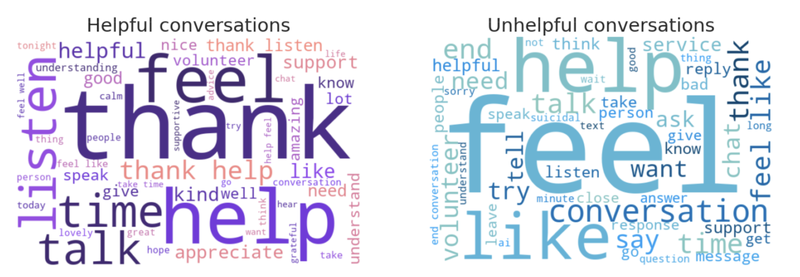
Most commonly used words in feedback notes associated with conversations rated as helpful (left) and not helpful (right).
Analysing texter feedback at scale

Given the high volume of texter feedback we receive, analysing it in a systematic way can prove challenging.

One approach – used by our qualitative researchers – is to read through randomly chosen examples to identify the most common themes. Though very powerful, this type of analysis can also be subjective and involves only a small subset of feedback, which risks missing less frequently mentioned yet significant themes.

To make sure that we ‘listen’ to the experiences of as many texters as possible, we also apply machine learning methods to all collected feedback.

This involves:

  • using language models pre-trained on vast amounts of text data to produce numerical representations of text that capture its meaning
  • automatically grouping reviews together based on their similarities

In this way, we can extract and explore the common themes discussed in tens of thousands of feedback notes.

Majority of Shout texters find the conversation helpful

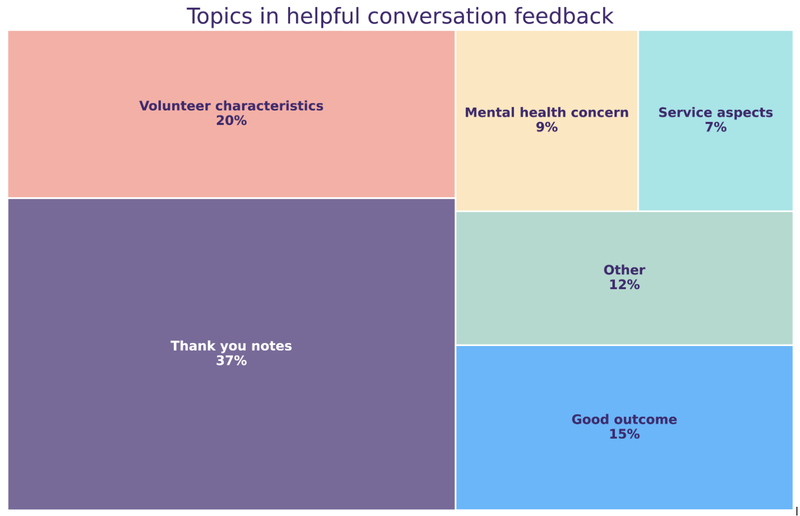
In 2024 and 2025, 84% of texters who provided freetext feedback also rated their conversation as helpful.

  • Most (37%) of them left a short thank you note for their volunteer, thanking them for their help, and for giving up their time to listen and support strangers in need.
  • One in five (20%) left a more personal note, praising their volunteer for their kindness, compassion, understanding, and non-judgemental support.
  • One in ten (8%) used the freetext field to comment on positive aspects of the service itself, such as useful resources and advice, or fast replies.

“Thank you so much for your time. It has helped to clear my head and set up a good action plan.”

Shout Texter

The remainder of the feedback touched on other themes, including remarks on the need for more funding dedicated to mental health services. Interestingly, despite having rated the conversation helpful, a small proportion (<1%) of texters reported it as feeling robotic or AI-driven – we discuss this theme in more detail in the next section.

report-topicfeedback

Most common complaints involve abrupt conversation endings and roboticism

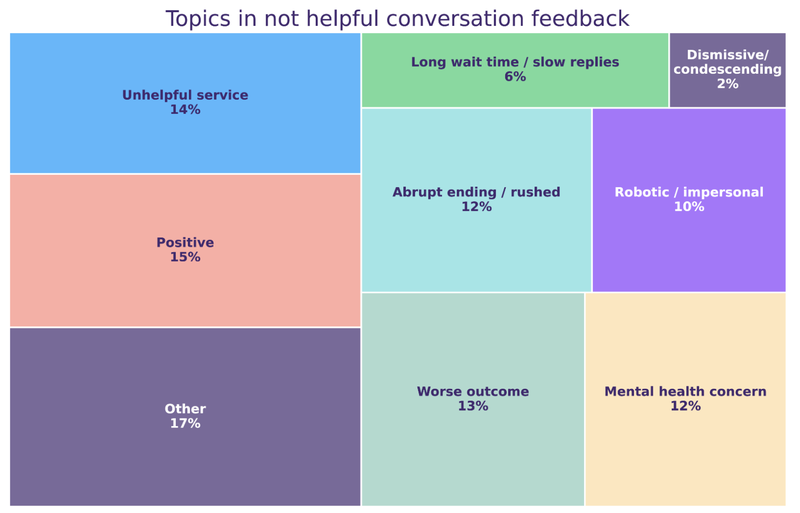
The perception of the conversation having been abruptly closed or rushed was one of the most common sources of complaints for conversations rated as not helpful.

Texters expressed frustration at the existence of time limits or discovering that they could no longer continue the chat after stepping away from the phone for a short moment (12%).

Another major theme – mentioned in 10% of all negative feedback – described the conversation as feeling robotic or impersonal, with users questioning whether they were talking to a person or an AI bot. We describe the follow-up work on both of these topics in the “Abrupt conversation endings” and “Roboticism” case studies at the end of this page.

“I was about to carry on texting and they closed the conversation”

Shout Texter

Other common sources of complaints referenced finding the overall service generally unhelpful (14%), sometimes attributing it directly to a lack of, or the quality of advice received.

A similar proportion of texters stated the conversation was unhelpful specifically in the context of a crisis, suicide, or self-harm (12%). Others quoted long wait times and slow replies (6%) or their volunteer being dismissive or condescending (2%).

"Not helpful in the slightest"

Shout Texter

Around 13% of texters shared thoughts about a bad conversation outcome, mentioning that it made them feel worse, more alone, or unheard.

Surprisingly, 15% of texters chose to leave a positive or partially positive review, even though they rated the conversation as not helpful. This category contained thank you notes for the volunteers – sometimes combined with tips for improvements – and acknowledgements that the volunteer tried their best to help but the user ultimately needed a different type of support.

The remainder of reviews touched on a variety of topics such as expressing disapproval at Shout being exclusively a text-based service – sometimes adding that it was too basic or limited to address complex mental health issues or problems – or frustration at having been brushed off by other mental health services, including the NHS.

Negative shout feedback

Summary

The majority of Shout texters who shared their feedback found the conversation helpful, often crediting:

  • the kindness and empathy of the volunteer
  • having the space to share and work through their thoughts and feelings
  • prompt replies
  • useful advice

In contrast, those who were not satisfied with their conversation often cited:

  • abrupt conversation endings
  • robotic conversation style
  • long wait times
  • slow replies
  • the quality or lack of advice given

To address the major areas for service improvement, we carried out follow-up investigations, updated the Shout volunteer guidelines, and developed automatic conversation quality monitoring systems – this work is described in more detail in the case study panels below.

Analysing anonymous survey responses allows us to investigate themes in positive and negative user feedback at a large scale. However, it is important to note that survey responses might be biased - for example, texters who were satisfied with their conversation might be more likely to leave feedback. Whilst such bias is difficult to eliminate completely, using a range of different approaches to explore user experiences can help to mitigate it.

In support of the findings described here, the insights gained from analysing texter feedback echo the themes identified through other channels.

For example, researchers from University of Glasgow conducted interviews with young people who have previously contacted Shout for help with suicidal thoughts and found that the key aspects of the experience that mattered to them were:

  • service availability
  • a person-centered approach involving compassion and curiosity
  • solution-focused support

These themes overlap with the comments regarding:

  • conversation wait and reply times
  • positive volunteer qualities (as well as roboticism and lack of personalisation)
  • the provision of advice and resources

Similarly, the Shout service User Voice Group – a group of previous service users spanning different age and ethnic groups, experiences of mental ill-health, and access needs – has been closely involved in shaping both research directions and improvements to the Shout service.

Amongst their suggestions were improvements to the messages texters receive when waiting for the conversation in the queue, intended to address some of the concerns related to long wait times – a theme discussed in the survey feedback for not helpful conversations.

The group has also drawn from their lived experience to:

  • provide valuable input regarding what kind of volunteer responses make them feel listened to
  • help shape additional questions asked in the texter survey related to conversation outcomes beyond overall helpfulness, such as feeling heard and understood

These insights have since been incorporated into volunteer training.

In summary, listening to the experience of Shout texters – through analysing thousands of anonymous survey responses and more in-depth consultations with smaller user groups – allows us to build a comprehensive view of what users appreciate about the service and pinpoint areas for improvement.

The most prevailing themes highlight the power of human compassion, curiosity, and collaboration in making those who reach out feel heard, empowered, and adequately supported in their time of need.