
We use necessary cookies that allow our site to work. We also set optional cookies that help us improve our website. For more information about the types of cookies we use, visit our Cookies policy.

Cookie settings
Man and boy walking the hills in winter

This article is adapted from our recent webinar with Dr Fiona Pienaar, Senior Clinical Advisor at MHI, Siân Evans, Head of Leadership and Development at Simplyhealth, and Dr Chris Agape Ajah, lead author of The New Childhood: Mental Health in a Connected Age from Imperial College London’s Institute of Global Health Innovation. Together, they explored how life transitions affect mental health across all ages and what we can do to better support people through them.

Life changes are normal. Starting a new school, going through a break-up, approaching retirement are all changes that although large and impactful, are things that most people go through at some point. Because they’re all so common, it can be easy to overlook the strain on mental health during this time - either on the part of the person going through it, or the people around them.

Even positive changes like parenthood or a new job carry stress. As can expected changes that don’t actually happen, like a job offer falling through, or a lost pregnancy. Life changes can be categorised into groups - the anticipated changes that never occur, expected changes and unexpected changes. All three can put pressure on mental health.

But as our Clinical Advisor Fiona Pienaar explained, there is an important distinction between the external change itself and the internal process of adjusting to it. Drawing on the work of William Bridges, she described how change is situational while transition is psychological: “a transition is the inner reorientation or self-redefinition that you have to go through to incorporate any of those changes into your life.”

That process of adjustment is where mental health can come under pressure, while the period Bridges called the “neutral zone” - when the old is gone but the new is not yet fully in place - is when people are often most vulnerable.

Feedback from Shout texters reflects this. People regularly reach out to the service in the middle of transitions, and consistently say that being heard made a difference.

“Thank you for talking with me today. I definitely feel a bit better about my new job”

Shout texter

The transition from primary to secondary school

The New Childhood: Mental Health in a Connected Age, a joint report from Mental Health Innovations and Imperial College London’s Institute of Global Health Innovation focuses on children aged 13 and under. It draws on a mixed methods study with children in school years 6 to 8, a children’s advisory group, interviews with Shout Volunteers, anonymised Shout service data, and interviews with professionals across health, education and children’s services.

Analysis of Shout data shows that 8 to 15% of conversations on the service since 2020 have come from children aged 13 and under, and 9% of all Shout texters fall within this age group. Meanwhile, NHS data shows that one in five children aged 8 to 16 have a probable mental health disorder, and more than half of all mental health disorders are believed to start before the age of 14.

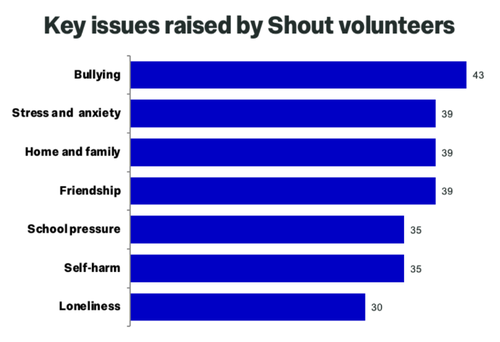
One of the key transitions affecting this group is the move from primary to secondary school. Children go from smaller classes with one teacher to larger settings with multiple teachers, navigating changes in friendships, social dynamics and academic expectations. Among survey respondents in the Middle Years Project, 18% said they felt sad or worried about schoolwork and exams nearly every day, especially before exams. Speaking on the most important issues for texters under 13, Shout Volunteers shared that their the top concerns were bullying, stress and anxiety, home and family, friendship, school pressure, self-harm and loneliness.

Key issues raised by young Shout texters

Barriers to accessing support

Critically, the report found that the presence of support does not always translate to children using it. Many of the children who text Shout do have adults they could talk to but prefer a text-based service because of the confidentiality, privacy it offers.

Children described specific barriers within schools to include needing a pass to access support which could signal to peers that something is wrong, being taken out of class and questioned on return, and drop-in sessions in publicly known locations that compromised their privacy. Dedicated mental health support is also not yet available in all primary schools, meaning a significant proportion of children cannot access help at the point when early intervention matters most.

Recommendations for children aged 13 and under

Children aged 13 and under have distinct developmental needs and require support designed around them. The focus for this age group should prioritise prevention and resilience, supporting children through difficult periods before their struggles become significant or lead to life altering mental healthdiagnoses.

Supporting children to adequately navigate early life transitions empowers them to handle the pressures that will come later in life

Dr Chris Agape Ajah, Lead Author of the 'The New Childhood'

The report makes recommendations across three groups.

  • For the Department of Health and Social Care and NHS England: integrate existing services and reframe the narrative around children’s mental health towards a focus on wellbeing and resilience.
  • For mental health service providers: expand and standardise provision in schools and communities, including primary schools, and better educate adults who care for children on how to support them.
  • For developers of digital mental health services: design tools tailored to the needs of under-13s, balance safeguarding with accessibility, and complement digital support with human support where possible.

When life transitions become workplace pressure points

Simplyhealth’s recent report, The Access Gap shows that mental health challenges are often triggered or intensified by major life transitions, not just by work itself. Eighty percent of employees agree that people at different life stages require different types of healthcare support, and 68% believe employers should tailor that support accordingly.

Four examples of transitions the report highlighted that create particular pressure are:

Becoming a parent: Up to a quarter of new and expectant mothers experience perinatal mental health problems. Returning to work often coincides with sleep disruption, identity change, childcare pressures and financial stress.

Caring for others: Adult carers are frequently tired, stressed and struggling to manage their own wellbeing. Many prioritise other people’s needs above their own, increasing the risk of stress and burnout.

Menopause and perimenopause: Symptoms can include anxiety, low mood, loss of confidence, poor concentration and brain fog. A quarter of respondents said specialist support around mental health or menopause would improve their access to care.

Approaching retirement: Retirement can bring major changes to routine, identity, finances and social connection. Uncertainty about the future may increase stress, anxiety or low mood during the transition.

Simplyhealth’s Siân Evans spoke about each of these from personal experience, including caring for two elderly parents while working full time, and navigating menopause. She described the difficulty of not knowing where to turn for help and the impact on confidence when symptoms such as brain fog went unrecognised.

woman working at laptop

As one example of how Simplyhealth is tackling mental health challenges that come with life stages, Siân talked about the introduction of ‘Menopause Champions’. These people have more understanding of menopause and can have a deeper conversation with someone about the symptoms they’re experiencing and know where to signpost.

The Access Gap report recommends that employers recognise life stages, not just job roles, and move beyond one-size-fits-all wellbeing support. It calls for faster, more flexible access to mental health support with clear signposting, and for managers to be equipped with the confidence to have meaningful conversations about mental health, caring responsibilities and personal change.

“Life stage support is really mental health support.”

Siân Evans, Head of Leadership and Development, Simplyhealth

What the conversation looks like, at each stage

A consistent theme across the discussion was the importance of listening and creating environments in which people feel safe to open up.

Shout Volunteers are trained to build rapport, explore and understand what someone is going through and help them find a calmer state. The service consistently receives feedback from texters saying they felt heard, often for the first time.

“Once people have got something out of their head and somebody else has witnessed it, it really does lighten things.”

Dr Fiona Pienaar, Senior Clinical Advisor, MHI

From a workplace perspective, Siân emphasised that managers do not need lived experience of every life stage to offer support. Often, listening without trying to fix the problem is enough. For those who may not recognise that they are struggling, she recommended reflecting back observable changes, such as withdrawal in meetings or changes to working patterns, rather than trying to diagnose or solve the issue.

Chris highlighted the value of peer and near-peer support, particularly for children and young people who are more likely to connect with people close to them in age and experience.

Whether someone is navigating a new school, a new job, caring responsibilities, or any other period of change, support is available. Anyone in the UK who is struggling to cope can text SHOUT to 85258, any time of day or night, to speak to a trained volunteer.

To watch the full webinar, please get in touch.

In your message, please let us know which webinar you're interested in