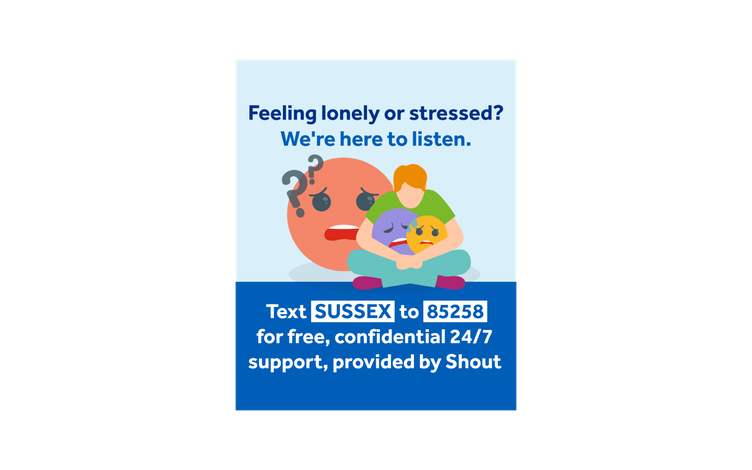
Why did you partner with MHI and our service, Shout?
Sussex Partnership NHS Foundation first partnered with Shout in 2022 to address a clear gap in local crisis support. At that time, there were no non-NHS services available 24/7 for people experiencing a self-defined crisis, and no services using text or written communication as the main route to support. Sussex’s 111 service didn’t have the capacity to offer support by text, and Shout was a trusted service with national recognition.
The partnership aimed to provide an open-access alternative for the people of Sussex, with particular benefit for groups less likely to engage with traditional services.
Furthermore, Shout provided valuable insights into unmet need through real-time analysis of messaging trends, informing decisions about how resources and digital support were directed across Sussex throughout the partnership.
After helping to reduce pressure on other parts of the system, including Emergency Departments and NHS 111 and 999, and in response to growing demand during its first three years, we transitioned from Shout’s volunteer-led service to its clinical model in 2025, with conversations taken by mental health professionals.
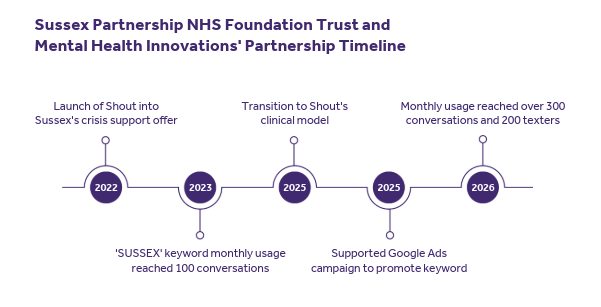
Timeline of Sussex Partnership NHS Foundation Trust and Mental Health Innovations’ partnership from 2022 to 2026.
What led to the transition from Shout’s volunteer-led service to the Clinical model?
The move was driven by a combination of national direction, growing local demand and the strength of the existing partnership with MHI, which all provided a strong foundation for further development.
Shout’s volunteer-led service was also positively received by both the Sussex mental health system and the people of Sussex, with the percentage of repeat texters using the ‘SUSSEX’ keyword being slightly higher (14%) than the national Shout profile (11%). Outcomes were marginally stronger in Sussex compared to the national average as well, in terms of feeling calmer (60% vs. 58% nationally), more able to work things out (86% vs. 83%) and higher ratings for dignity and respect (86% vs. 83%) .
Growing demand for the service across Sussex, alongside positive feedback on Shout’s volunteer model, strengthened the case for a more clinically responsive model aligned with national expectations.
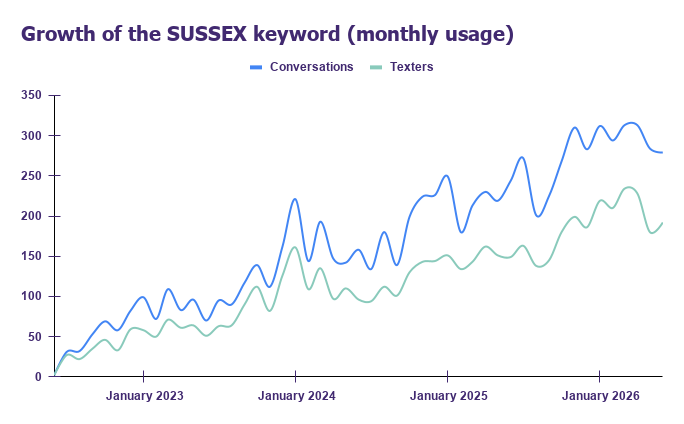
The monthly usage of the ‘SUSSEX’ keyword from 2022 to 2026.
Since the partnership began in July 2022, usage steadily increased and by March 2023 the service reached the milestone of 100 conversations in a single month. From September 2023 onwards, thanks to a continued focus on awareness raising through various different channels and campaigns, usage has shown a steady upward trend. Four years later, the service is achieving an average of 300 conversations and 200 texters per month. This highlights the integration of Shout into Sussex’s crisis support offer and growing awareness of the service among the local community.
What changes have you observed since partnering with Shout, and have these influenced system-wide conversations about digital crisis support and strategy?
There has been a reduction in NHS 111 calls, which may reflect the availability of alternative crisis support routes, including Shout, and increased signposting to local services.
Surprisingly, the ‘SUSSEX’ keyword has shown to be well-utilised by older adults, with higher use among people aged over 35 in the Sussex region compared to the national Shout profile. The gender profile of texters also differed from the national picture, with a higher proportion identifying as non-binary or transgender in Sussex (9.9% vs. 7% nationally), demonstrating Shout’s role as a perceived safe and inclusive place to seek support for Brighton & Hove’s established LGBTQ+ communities. This demonstrated the value of a confidential, SMS text-based, all-age support service in reaching people who may not otherwise seek help.
“Thank you for hearing me. I’ve not thought of it all that way before. I feel in control to fight another fight.”
- Sussex texter feedback
Shout has contributed to the wider crisis strategy by adding an alternative route into support. Alongside face-to-face provision through Staying Well and telephone access via NHS 111 Mental Health, the partnership offers a free text-based option for people who prefer or need written communication.
How have Shout data insights supported Sussex Partnership NHS Foundation?
Shout has provided valuable insight into unmet need through real-time analysis of messaging trends, helping us better understand patterns of distress, emerging themes, gaps in existing provision and how these needs change over time to aid decision-making.
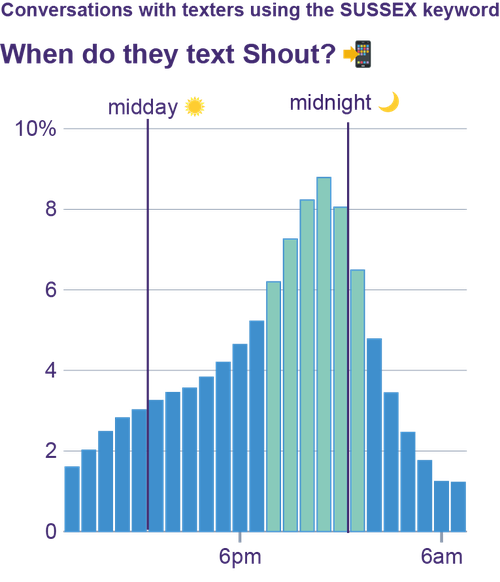
For instance, Shout data showed activity peaking outside of traditional 9am-5pm service hours. This reinforced the need for accessible out-of-hours provision and supported the case for maintaining a range of entry points into crisis support.
Analysis of Shout conversations from the ‘SUSSEX’ keyword also identified higher rates of low mood and sadness (38% vs. 34% nationally), as well as stress and worry (37% vs. 32%), compared to the Shout national profile. These real-time insights have helped shape campaign themes and promotional activity throughout the partnership, including recent work to align Text ‘SUSSEX’ materials with the local How are you really feeling? Campaign.
What has influenced Sussex to maintain its partnership with Shout over the past four years?
Through our partnership with Shout, we have been able to reach people who may have found it difficult to engage with traditional mental health support, while also seeing growing levels of activity, particularly among younger age groups. Ahead of the under-16s social media ban, we are confident about the service’s potential to support increased numbers of children and teenagers in the area if required. The service is now recognised and integrated across the system as an important part of the Sussex-wide crisis support offer and is used as a key signposting option.
MHI has played an important role in supporting this success through clear and responsive communication, practical marketing support and access to useful data and insights. Promotional activity, including the Google Ads campaign and marketing materials, helped increase awareness of the ‘SUSSEX’ keyword and contributed to increased engagement with the service. In four years, our keyword service has gained visibility and become an established and embedded part of the wider crisis support offer.
Thus, Sussex has remained committed to the service because of the strength of the partnership, the service’s national recognition, consistency of offer and the growing evidence that it is becoming more widely used and understood locally.
“Thank you, you most likely saved my life and I will always be grateful for that.”
- Sussex texter feedback